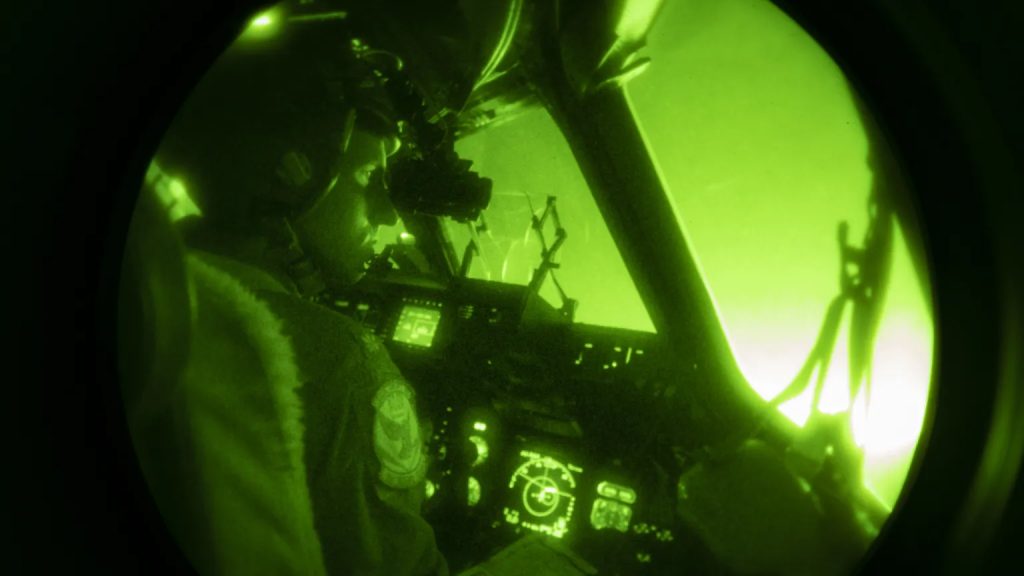
Image courtesy of US Air National Guard / Mysti Bicoy
Night operations introduce a unique challenge for human-machine interface design. Displays, indicators, and illuminated controls must remain visible to the operator while avoiding interference with night vision imaging systems (NVIS). Even small amounts of incompatible light output can reduce night vision goggle (NVG) effectiveness, impacting situational awareness and mission safety.
To address this, military and aerospace systems rely on MIL-STD-3009, the standard that defines requirements for lighting, displays, and illuminated components used in NVIS environments. Grayhill evaluates NVIS compatibility to ensure that interface components meet these requirements and perform reliably in low-light and night operations.
Why NVIS Compatibility Matters
Night vision systems amplify low levels of light, allowing operators to see in near-dark conditions. However, they are highly sensitive to specific wavelengths, particularly in the near-infrared spectrum.
If a display or indicator emits light in these sensitive ranges, it can:
- Bloom or wash out the NVG image
- Reduce contrast and visibility
- Obscure critical information
- Degrade overall system performance
This makes NVIS compatibility essential for:
- Military aircraft cockpits
- Ground vehicles and tactical systems
- Naval operations
- Law enforcement and surveillance equipment
Lighting must be carefully controlled so that it is visible to the human eye without interfering with night vision systems.
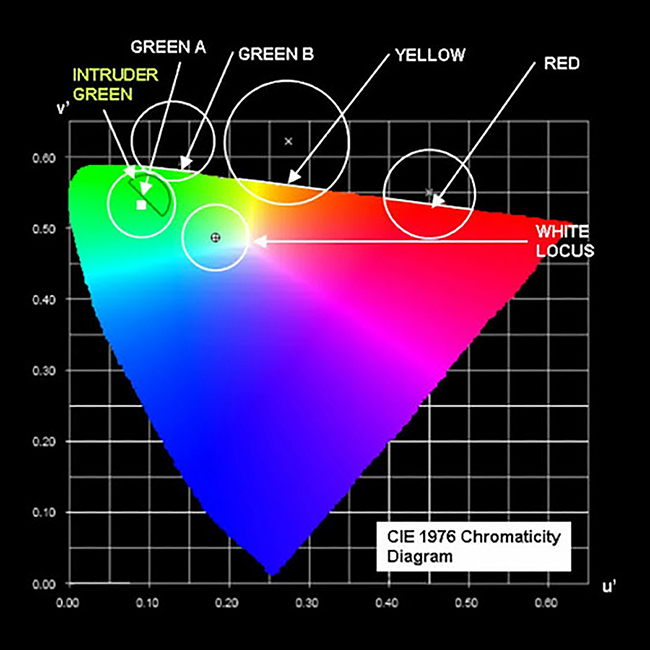
The 1976 CIE Chromaticity Diagram
GREEN A (General): A less saturated (and less fatiquing) green matching the eye's maximum luminous efficiency.
GREEN B (Indicators): A more saturated green for greater attensity and daylight readability.
YELLOW (Caution): A low red content yellow initially intended for warnings and master caution only.
RED (Warning): A high orange content red developed as an option for use in warning indicators instead of yellow.
WHITE (Chart): Introduced where Green A would interfere with reading colored images or diagrams.
What MIL-STD-3009 Defines
MIL-STD-3009 establishes requirements for lighting and display systems used in NVIS environments. It focuses on ensuring compatibility between visible lighting and night vision devices.
The standard defines:
- Spectral Radiance Limits: Controls the amount of energy emitted in NVG-sensitive wavelength ranges to prevent interference.
- Color Requirements: Defines acceptable colors and chromaticity ranges for NVIS-compatible lighting.
- Luminance Levels: Specifies brightness limits to balance human visibility with NVG performance.
- NVIS Radiance Classes: Establishes categories such as NVIS Green A, NVIS Green B, NVIS White, and NVIS Red, each with defined spectral and luminance constraints. These requirements ensure that lighting systems support both direct human viewing and NVG-assisted operation.
What NVIS Testing Evaluates
Grayhill evaluates several key characteristics to determine whether illuminated components are suitable for NVIS environments.
- Spectral Radiance: Measures how much light is emitted across different wavelengths, particularly in the NVG-sensitive near-infrared region.
- Color Compliance: Ensures that emitted light falls within defined chromaticity boundaries for NVIS-approved colors.
- Luminance Levels: Evaluates brightness to confirm that the display is readable without overwhelming night vision systems.
- Filter and LED Compatibility: Assesses how filters, coatings, and LED selections influence spectral output and NVIS performance.
- Operational Suitability in Low-Light Environments: Considers how displays and indicators perform in realistic night conditions, including visibility, contrast, and readability.

How Grayhill Evaluates NVIS Performance
Grayhill evaluates NVIS compatibility using controlled testing conditions designed to assess light output and visual performance in low-light environments.
These evaluations focus on:
- Measuring light output characteristics across relevant wavelength ranges
- Assessing brightness and contrast under low ambient light
- Evaluating how filters and materials affect spectral performance
- Confirming that illuminated components meet the intent of MIL-STD-3009 requirements
By analyzing these factors, engineers can determine whether a display or indicator will function effectively in NVG-supported environments without introducing interference.
How NVIS Testing Supports Interface Design
NVIS evaluation is not only about pass or fail criteria. It also informs design decisions that improve performance and compatibility.
Grayhill uses NVIS test data to:
- Select LEDs with appropriate spectral characteristics
- Apply filters that suppress NVG-sensitive wavelengths
- Optimize brightness levels for dual-mode visibility
- Balance human readability with NVG compatibility
- Ensure consistent performance across varying environmental conditions
These design considerations help create interfaces that perform reliably in both daytime and night operations.
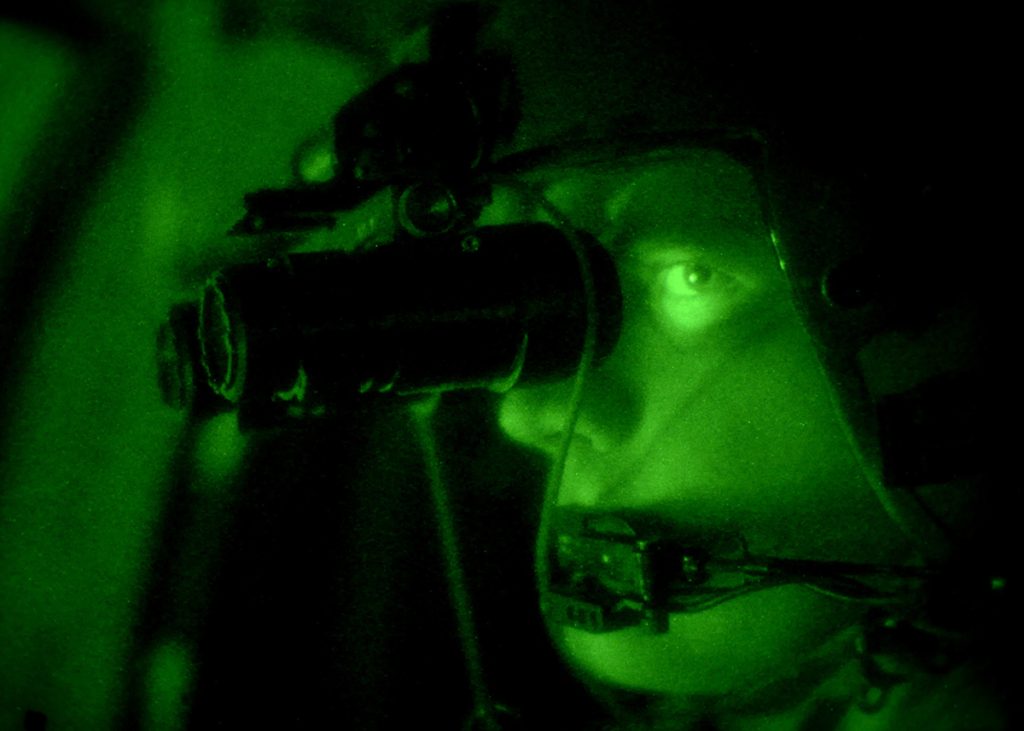
Image courtesy of U.S. Navy photo by Mass Communication Specialist 1st Class Michael Larson)
Customer Benefits
For customers designing systems used in night operations, NVIS-compatible components provide:
- Improved visibility in low-light conditions
- Reduced risk of NVG interference
- Greater situational awareness for operators
- Compliance with military and aerospace requirements
- Reliable performance across mission environments
For mission-critical applications, these benefits are essential to both safety and operational effectiveness.