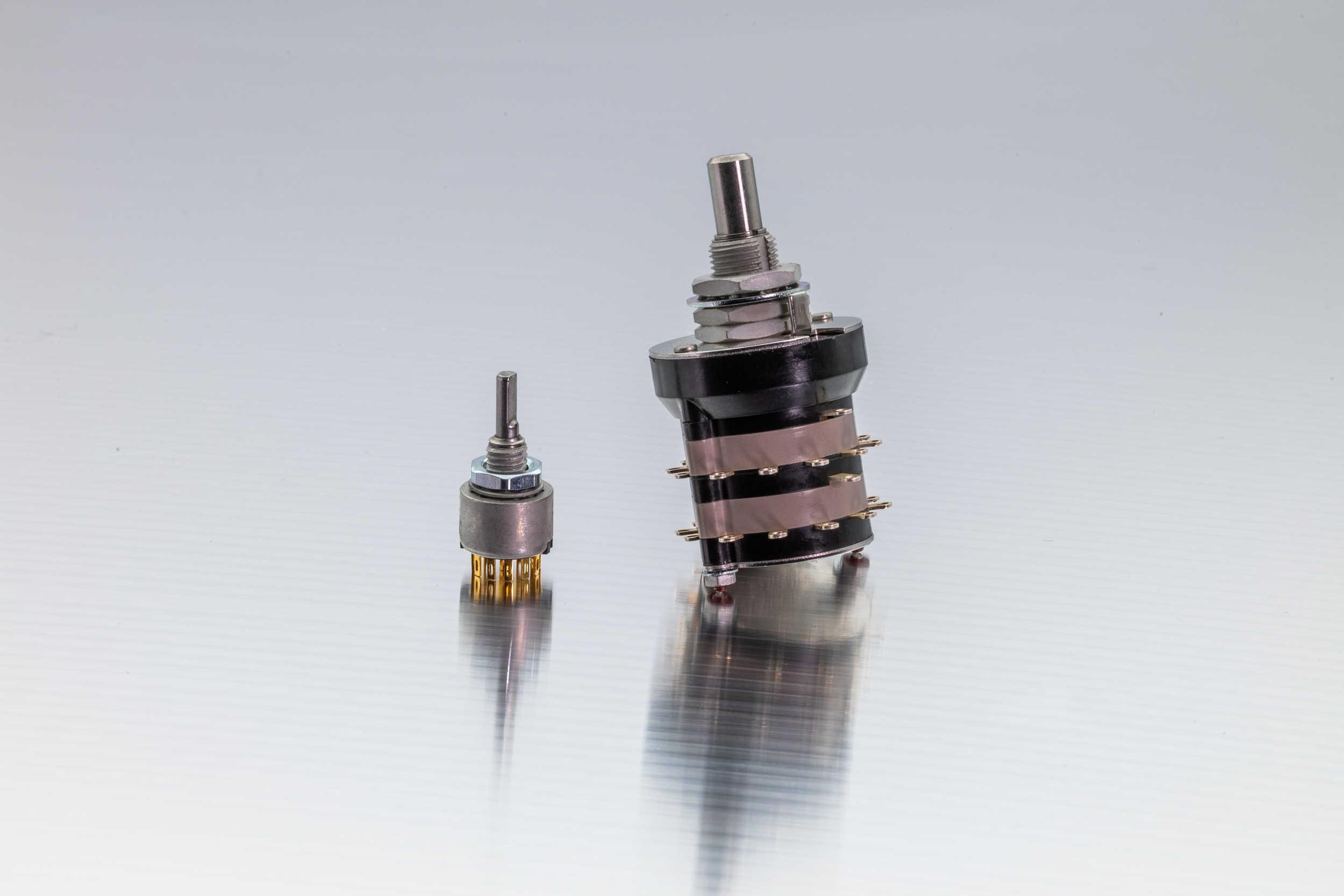
If you already know you need a rotary switch, the next decision isn't which part number to choose. It's how the switch should be built. The difference between a single-deck, multi-deck, or concentric configuration isn't a minor detail. It directly affects how your system functions, how much space it takes up, and how reliable it is over time.
This is where designs either stay simple—or become more complicated than they need to be.
What is the difference between single-deck, multi-deck, and concentric rotary switches?
- Single-deck rotary switches control one circuit per position and is used for simple, direct control applications.
- Multi-deck rotary switches control multiple independent circuits with a single rotation, making it ideal for systems that require multiple outputs, redundancy, or higher current handling.
- Concentric rotary switches use two shafts—an inner and an outer control—to provide independent inputs in a single device, allowing more functionality in limited panel space.
Choosing between these configurations depends on how many circuits need to be controlled, whether redundancy is required, and how much space is available in the design.
What is a single-deck rotary switch?
A single-deck rotary switch controls one circuit per position. It is the simplest configuration and is often the right choice when the application itself is straightforward. Each position corresponds to a single electrical path, which makes the design predictable and easy to integrate.
Single-deck switches are typically used when:
- Only one function needs to be controlled
- System complexity is low
- Wiring simplicity is preferred
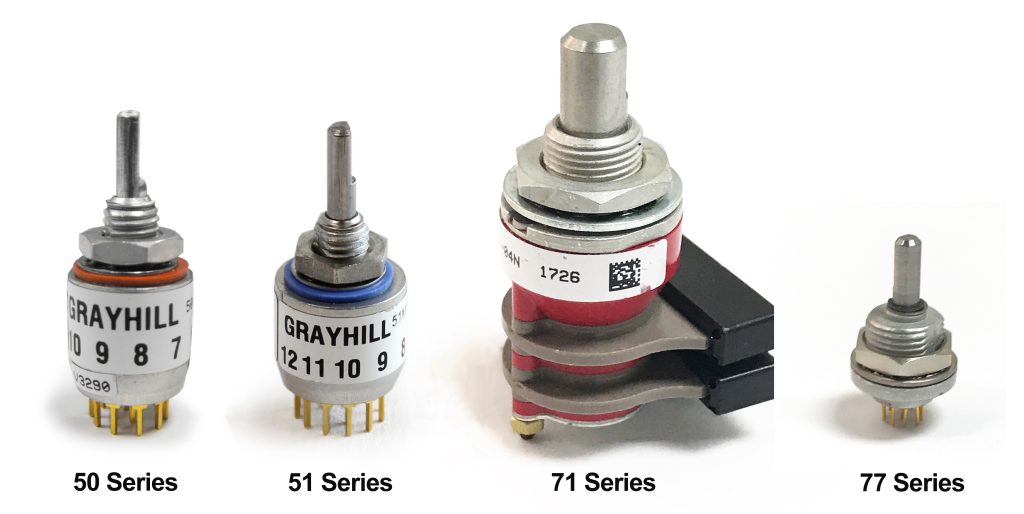
GRAYHILL offers several single-deck families, each tuned to a different constraint:
- 50 Series: the standard-applications baseline. 0.5" diameter, 200 mA, .698" behind panel, up to 4 poles, 36°/45°/60°/90° angles of throw, up to 10 positions per pole.
- 51 Series: for higher position counts. Same footprint and rating as the 50 Series, but at 22.5°/30° angles of throw it supports up to 16 positions per pole (vs. the 50's max of 10).
- 56 Series: for space-constrained designs. Same 0.5" diameter and 200 mA rating, but only .355" behind panel (roughly half the depth of the 50/51), plus adjustable-stop versions for fast prototyping.
- 77 Series: for short behind-panel depth. The shallowest of the family at just 0.18" behind panel, purpose-built for handheld radios, handheld medical devices, night vision products, and laser aiming devices where panel depth is at a premium.
What is a multi-deck rotary switch?
A multi-deck rotary switch stacks multiple switching layers into one device. Each deck operates independently, allowing multiple circuits to be controlled with a single rotation. This transforms the switch from a simple selector into a more capable system control.
Multi-deck rotary switches are used when systems require:
- Multiple actions from a single input
- Higher current handling across circuits
- Built-in redundancy
The 71 Series is GRAYHILL's dedicated multi-deck platform:
.5"–.75" diameter, 1/4 amp rating, 30° or 36° angle of throw, and support for up to 12 decks in a single switch. It's built specifically to stack multiple independent switching layers behind one shaft, making it the natural fit whenever a design needs to control several circuits from a single rotation.
When should you use a multi-deck rotary switch?
A multi-deck rotary switch should be used when a system needs to control multiple circuits simultaneously, reduce panel space, or introduce redundancy for reliability.
Instead of adding multiple switches, one properly configured device can simplify the entire interface.
Why multi-deck configurations matter
In real applications, multi-deck designs solve problems like:
- Redundancy: If one circuit fails, another can continue operating
- System simplification: Multiple outputs can be triggered from one control
- Space efficiency: Fewer panel components are required
This is especially valuable in industrial, military, and off-highway environments where reliability and space are both constrained.
Concentric Rotary Switches: More Control in Less Space
A concentric rotary switch uses two shafts—an inner and an outer shaft—each controlling a different function. This allows two independent inputs in the footprint of a single control.
What is a concentric rotary switch used for?
A concentric rotary switch is used in applications where multiple inputs are needed but panel space is limited. It allows an inner and outer shaft to control separate functions, often used for coarse and fine adjustments.
GRAYHILL's 71 Series (Concentric Shaft, Style C/CF):
The concentric-shaft version places two independent 71 Series switch sections back-to-back on one shaft, giving you two switches in the panel space of a single shaft rotary. Each section can be specified with its own deck count, pole count, and position count, so the front (Section A) and rear (Section B) controls can be configured independently.
Why concentric designs are effective
Concentric designs allow engineers to:
- Reduce panel clutter
- Combine multiple controls into one location
- Maintain intuitive user interfaces
This becomes especially important in space-constrained systems or interfaces with high functionality requirements.
Comparison: Single-Deck vs. Multi-Deck vs. Concentric
| Feature | Single-Deck Rotary Switch | Multi-Deck Rotary Switch | Concentric Rotary Switch |
|---|---|---|---|
| Circuits Controlled | One | Multiple (stacked decks) | Independent inner/outer |
| Complexity | Low | Medium–High | Medium |
| Space Efficiency | Low | Medium | High |
| Redundancy | No | Yes | Possible |
| Best Use Case | Simple control | Multi-function systems | Compact UI with multiple inputs |
| Recommended Product | 50 / 51 / 56 / 77 Series | 71 Series | 71 Series (Concentric Shaft) |

Stops, Positioning, and Operator Control
Rotary switches are typically designed with defined stops and detents. These features directly influence how the control behaves in real use. Stops limit rotation to a defined range, while detents provide tactile feedback at each position.
This matters because it:
- Prevents over-rotation
- Improves repeatability
- Helps operators confidently select positions
In applications where accuracy matters, this feedback is essential.
Push-to-Turn and Pull-to-Turn Mechanisms
Some designs require an intentional action before rotation, such as push-to-turn or pull-to-turn. These mechanisms are used when accidental changes would create risk or operational issues.
You'll typically see them in applications where:
- Safety is critical
- Settings must not change unintentionally
- Equipment operates in high-vibration environments
They add protection without increasing overall system complexity.
Sealing and Environmental Performance
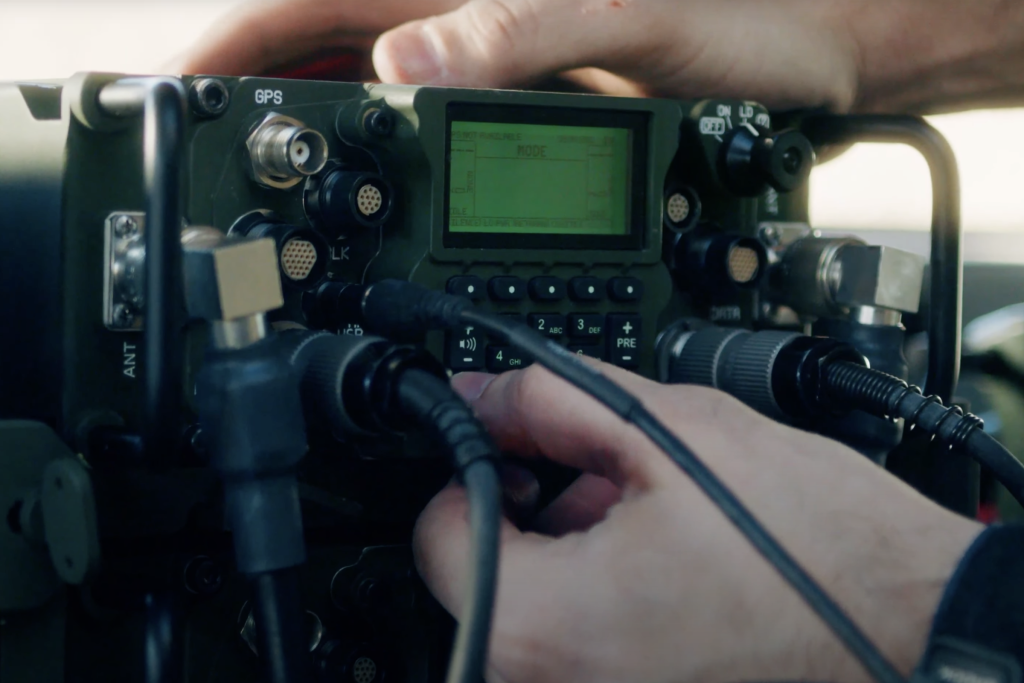
In harsh environments, sealing is not optional. Rotary switches can be designed with shaft and panel sealing to protect against dust, moisture, and contaminants. If sealing is not considered early in the design process, failures often appear later in the field rather than during testing.
This is one of the areas where proper configuration decisions have the greatest long-term impact.
When a Mechanical Encoder Might Be the Better Choice
Even when a design starts with a rotary switch, it is worth evaluating whether an encoder would be more appropriate.
A mechanical encoder is often the better option when:
- You want to reduce wiring complexity
- A microcontroller is already present
- You do not need to switch current directly
For example, the GRAYHILL 26 Series Mechanical Encoder provides encoded output while simplifying system integration in digital applications.
GRAYHILL Rotary Switches
GRAYHILL designs rotary switches for applications where reliability, flexibility, and performance are critical.
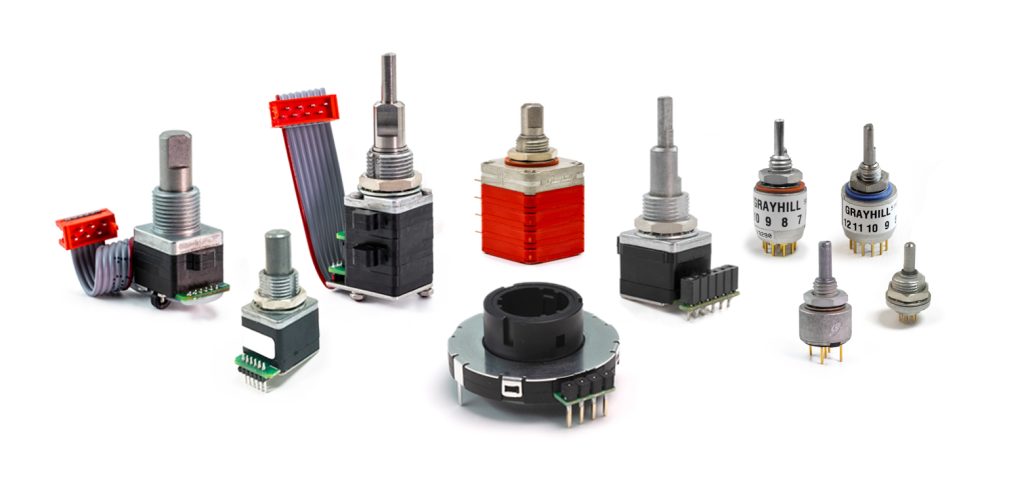
Core rotary switch families include:
- 50 Series Single Deck Rotary Switch: for standard applications
- 51 Series Single Deck Rotary Switch: for higher position counts
- 56 Series Single Deck Rotary Switch: for space-constrained designs
- 77 Series Single Deck Rotary Switch: for short behind-panel depth
- 71 Series Multi-Deck Rotary Switch: for multi-deck configurations and for concentric designs
These solutions are used across industrial, military, and transportation applications where performance requirements are demanding.
How to Choose the Right Rotary Switch Configuration
At this stage, the decision comes down to your system requirements:
- Do you need to control multiple circuits at once?
- Is redundancy required?
- Is panel space limited?
- Do you need multiple inputs in one control?
- What environmental conditions must the switch withstand?
Answering these questions will guide you toward the correct configuration before selecting a specific product.
Next Step: Find the Right Device
Once the configuration is defined, the next step is selecting the right solution for your application.
👉 Start here: Rotational Controls Selector