Your Supplier's Million-Cycle Rating May Not Mean What You Think
When you’re evaluating rotary encoders for a new interface, the spec sheet is typically your North Star. If two different suppliers both claim a 1-million-cycle life, it’s logical to assume their components offer the same longevity.
But in reality, these two numbers are based on entirely different definitions. To get the full truth, you need to know how the manufacturer is measuring a single lifecycle.
Before you benchmark any encoder, it’s worth asking three questions:
- What counts as 1 cycle?
- Under what conditions was that number tested?
- What does end-of-life actually look like?

The Math Problem: Clicks vs. Rotations
The industry lacks a universal definition for a cycle, and some manufacturers use this ambiguity to make their products look more durable on paper than they actually are.
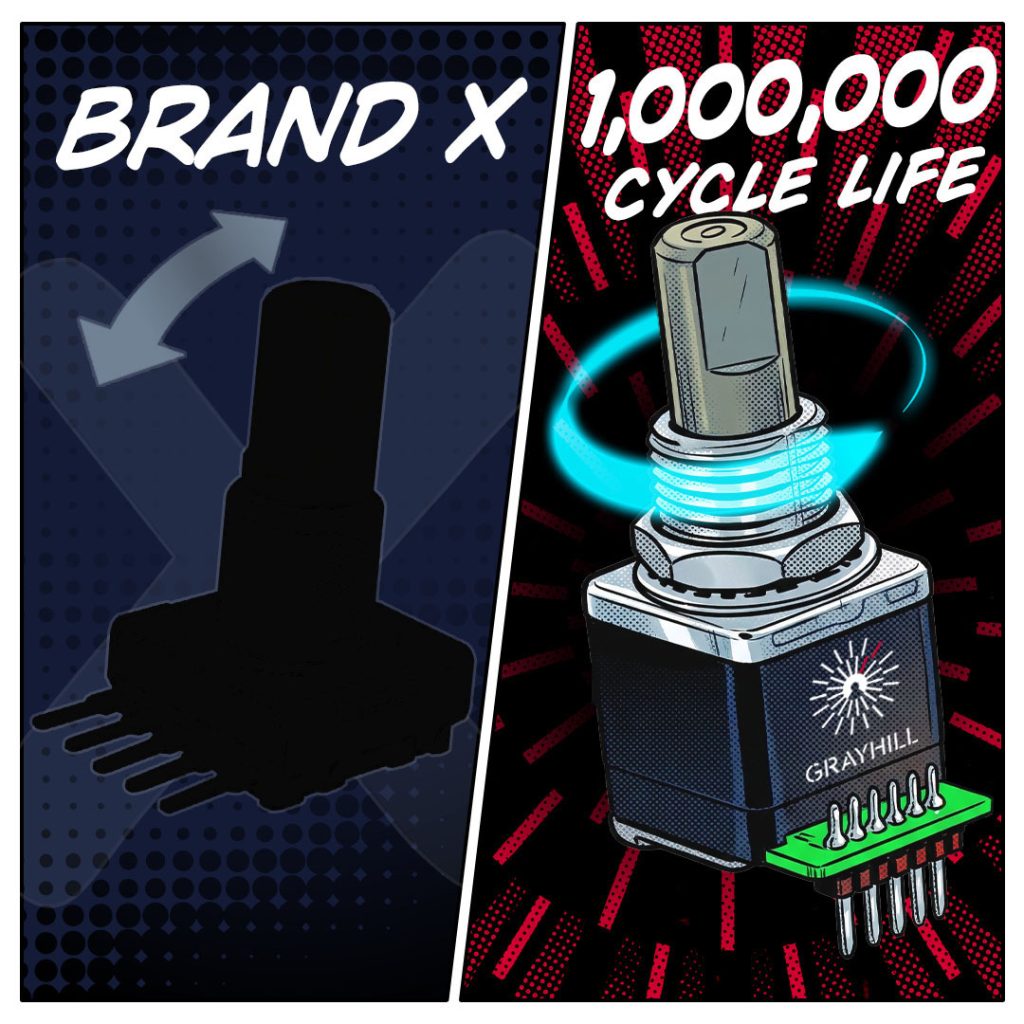
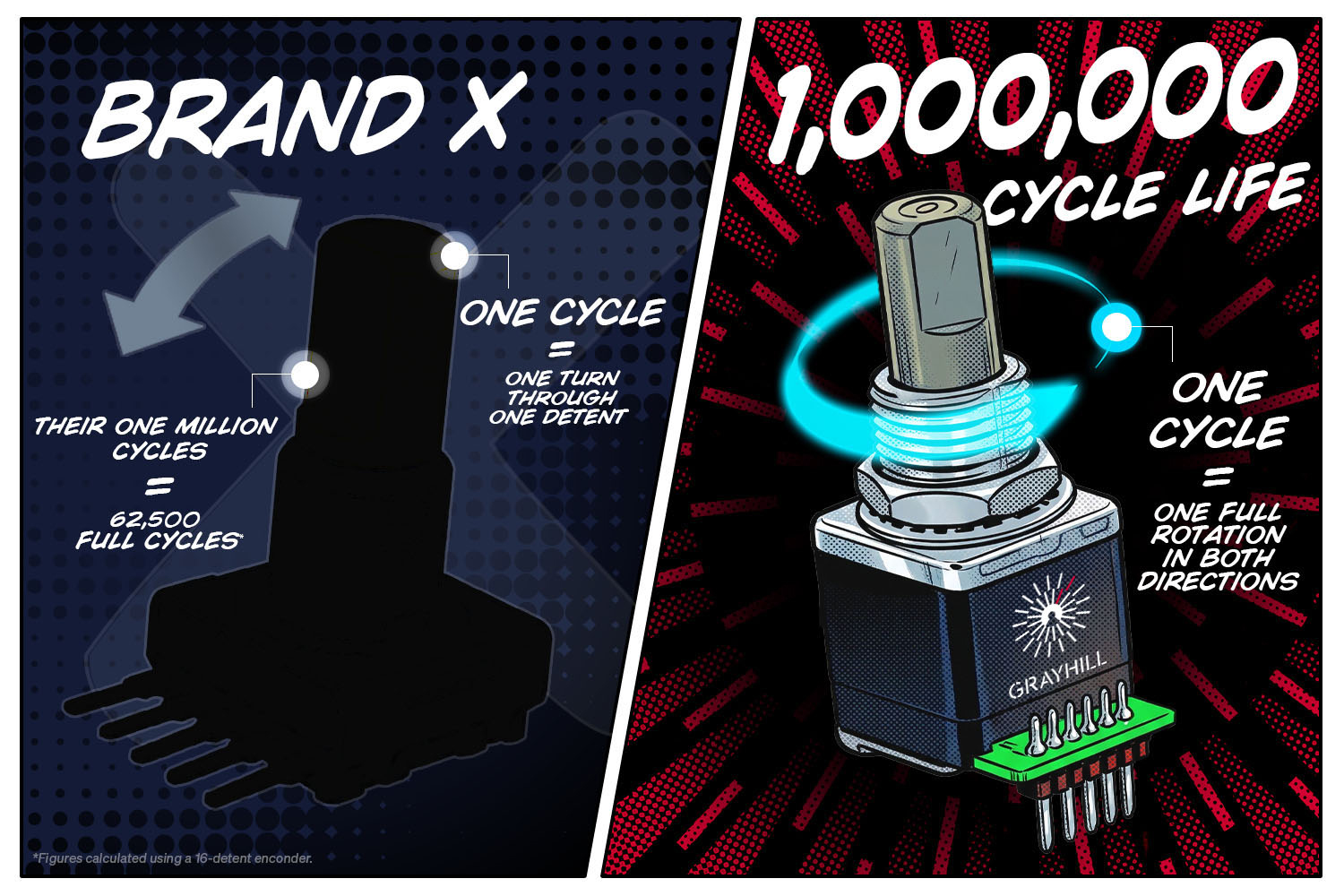
The “Flexible” Definition: For some manufacturers, a single detent position change is counted as a full cycle.
The Grayhill Standard: We hold our Series 62AG and Series 62SG Value Rotary Encoders to a much higher standard. We define one cycle as a complete 360° clockwise rotation through every position, followed by a full 360° counter-clockwise return to the start. On a 16-position encoder, that means every detent is crossed twice—once in each direction—before we log a single cycle.
Why does this matter? Because if a manufacturer counts every click as a cycle, their “1 million” rating might actually represent only a fraction of the mechanical wear that you think you’re getting.
To put the difference in practical terms: a medical device interface actuated 50 times per day reaches 1 million Grayhill-defined cycles in roughly 55 years. The same device, running on a competitor encoder rated by single detents on a 16-position encoder, may hit end-of-life in under 4 years. That gap won’t show up on the spec sheet, but it could show up in your warranty claims.

Contactless Encoders Are Engineered to Last Much Longer
Achieving a true 1-million-cycle lifespan requires superior internal architecture. A primary reason Grayhill encoders outlast the competition is our use of contactless light pipe technology.
Traditional encoders often rely on mechanical contacts that rub together during every rotation. Over time, this friction generates metal shavings and debris that lead to signal noise and miscodes. Under continuous or high-load operating conditions, contact-based encoders can reach end-of-life in as few as 30,000 cycles.
Grayhill’s contactless design eliminates this physical wear cycle entirely. By removing friction-heavy components, we ensure a flat performance curve where the haptic feel and signal integrity remain consistent from the first use to the millionth.
From Fuzzy Math to Warranty Headaches
Choosing an encoder based on an inflated rating impacts performance and creates a significant warranty liability for OEMs. When you build a service life assumption into your product warranty based on a misleading datasheet, the consequences stack up quickly:
- Premature Failure: Your warranty math is only as good as the lifecycle definition behind it. If a competitor's "1 million cycles" represents 62,500 full rotations, the encoders in your product may fail long before your warranty window closes.
- Unbudgeted Costs: You end up absorbing the cost of field failures and warranty claims that were never part of the project’s financial plan.
- Reputational Damage: Your customers depend on an intuitive interface that works every time. If a knob skips positions or loses its crisp feel, it turns a reliable instrument into a liability.

Tested Under Real Conditions, Not Optimized Ones
A lifecycle rating is only meaningful if the test behind it reflects how the encoder will actually be used. Some manufacturers validate cycle life in controlled lab environments with moderate temperatures, minimal shaft loading and low actuation speed—conditions that favor a high number, not real-world durability.
Grayhill's 1 million cycle rating is validated across an operating temperature range of -40 °F to 185 °F (-40 °C to 85 °C) and across both low-torque (2.0 in-oz) and high-torque (3.5 in-oz) configurations. When you see our number, you're seeing performance that has been earned under conditions that reflect the demands of your application, not conditions designed to make the spec sheet look good.
Whether your application requires the light touch of a low-torque encoder or the heavy, deliberate feel of a high-torque model, our testing ensures that the haptic integrity remains stable. In fact, our optical encoders are guaranteed to maintain 40-50% of their initial torque to 1 million full cycles, providing the consistent, non-degraded performance that mission-critical OEMs require.
Before you specify your next encoder, ask your supplier how they count to a million and test the parameters behind the claim. If their explanation doesn’t hold up under pressure, your product won’t either.
For the bigger picture on why inflated lifecycle ratings become warranty liabilities — and how to spot them before they cost you — read our companion article: How to Decode Encoder Lifecycle Ratings.
Want to know which competitors are inflating their numbers?
Contact a Grayhill engineer today for a deep dive into our comparative test data.