












If a Specification Is Built on Fiction, It Belongs in a Comic Book
For OEMs who stand by their products and their warranties, understanding the true lifespan of a component is critical. The problem is that some encoder manufacturers use a different definition of "lifecycle" that makes their products look impressive on paper. When a rating is based on creative math rather than rigorous testing, it crosses the line from technical data into pure fantasy.
This guide pulls back the curtain on inflated cycle claims so you can find the real-world engineering your application requires.
The Anatomy of Encoder Lifecycles: Why "1 Million Cycles" Doesn't Always Mean What They Say It Does
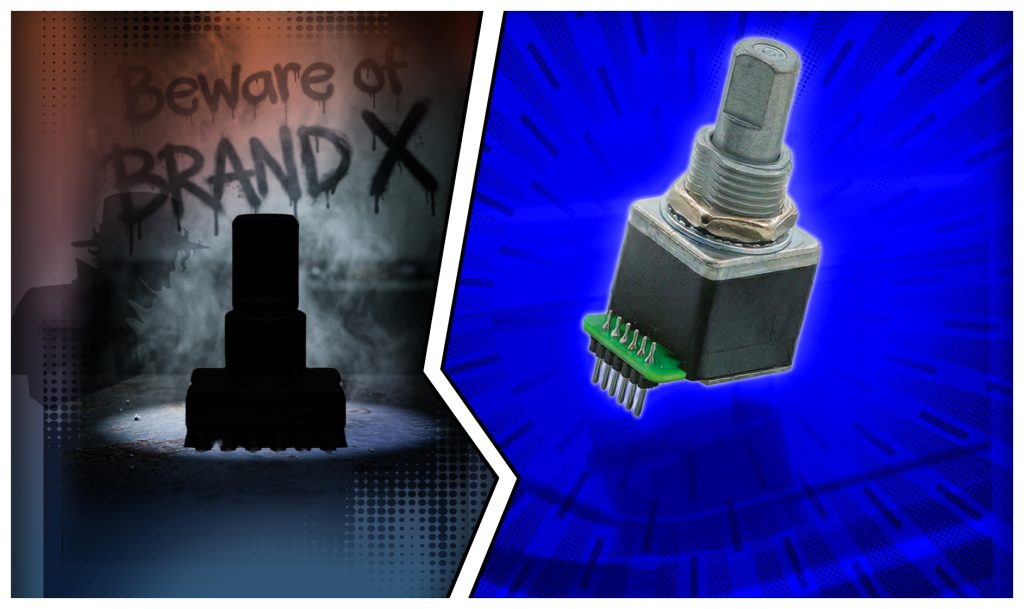
If you compare two brands of encoders and both claim a 1-million-cycle life, you'd naturally assume they are equivalent. Before you accept that number at face value, it helps to understand how manufacturers define a lifecycle — because not everyone is counting the same way.
At Grayhill, the definition is precise. For our Series 62AG and Series 62SG Value Rotary Encoders, one cycle is a full 360° clockwise rotation through all positions, followed by a full 360° counter-clockwise return. This captures the total mechanical work performed by the bearings, detents, and internal springs across the entire range of motion. That is the standard we hold ourselves to and the standard we think every OEM deserves from every supplier.
Not every manufacturer sees it that way. For some, the definition of a "cycle" is surprisingly flexible. A single detent position change is all it takes to count a cycle.
On a 16-detent encoder, that math gets ugly fast: their advertised "1 million cycles" represents only 62,500 full rotations — a fraction of the mechanical wear an OEM thought they were specifying.
From Fuzzy Math to Warranty Headache
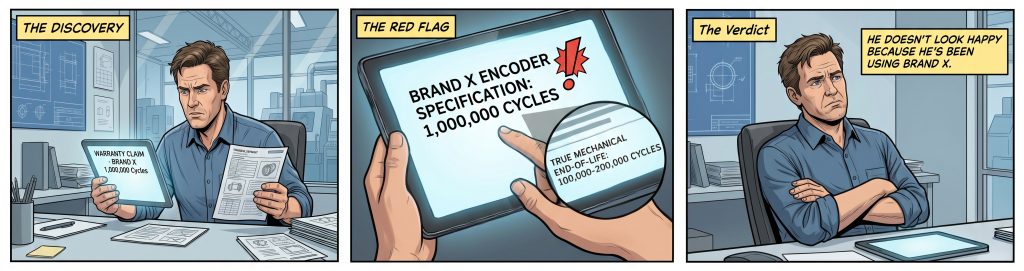
What starts as a competitor's fuzzy math can become an OEM's very real warranty headache. When a manufacturer specifies an encoder based on a published 1-million-cycle rating, they're building a service life assumption into their warranty terms. If that rating is inflated, the consequences stack up fast:
- The encoder reaches true mechanical end-of-life at 100,000 or 200,000 cycles, well before the warranty window closes.
- Warranty claims that were never budgeted for come in, because the spec sheet never reflected real mechanical wear.
- The competitor whose inflated number started the chain bears none of the cost. The OEM who trusted the datasheet absorbs it all.
The inflated number didn't just mislead. It embedded a service life expectation into your warranty terms that the component was never capable of fulfilling.
The difference between a rated cycle life and a real one starts with a definition. Make sure your encoder comes from a supplier whose definition holds up under pressure.

The Invisible Enemy: How Torque Drift Makes Your Encoder a Liability in Disguise
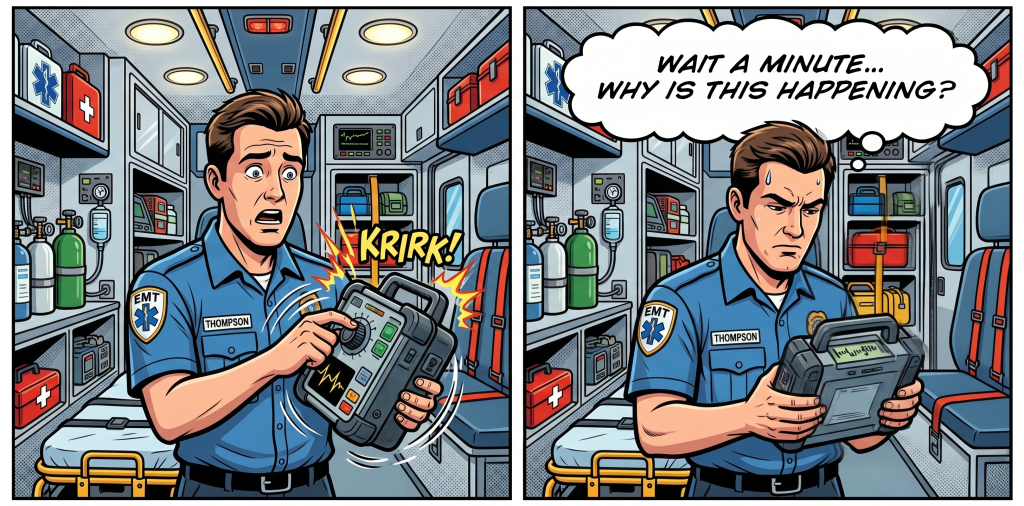
Every encoder experiences torque drift. Detents wear. Springs fatigue. The tactile resistance that gives an operator confident positional feedback at the start of a product's life will not feel exactly the same at the end of it. Encoder manufacturers know this. The question is how quickly it will drift, and what that means for the operator who depends on it.
Think of it this way: you turn a knob one click, expecting it to land on position four. Instead it skips to five — or settles somewhere between three and four with no crisp confirmation either way. In a consumer device, that's a frustration. In an operating room, a cockpit, or an off-highway cab where the operator is trained to trust that one click means one position, that ambiguity turns a reliable interface into a liability.
How Grayhill Holds the Line on Torque Consistency
No encoder manufacturer can completely eliminate torque drift. What they can do is rigorously engineer against it, validate it at every stage of manufacturing, and define end of life at the point where drift matters to the operator.
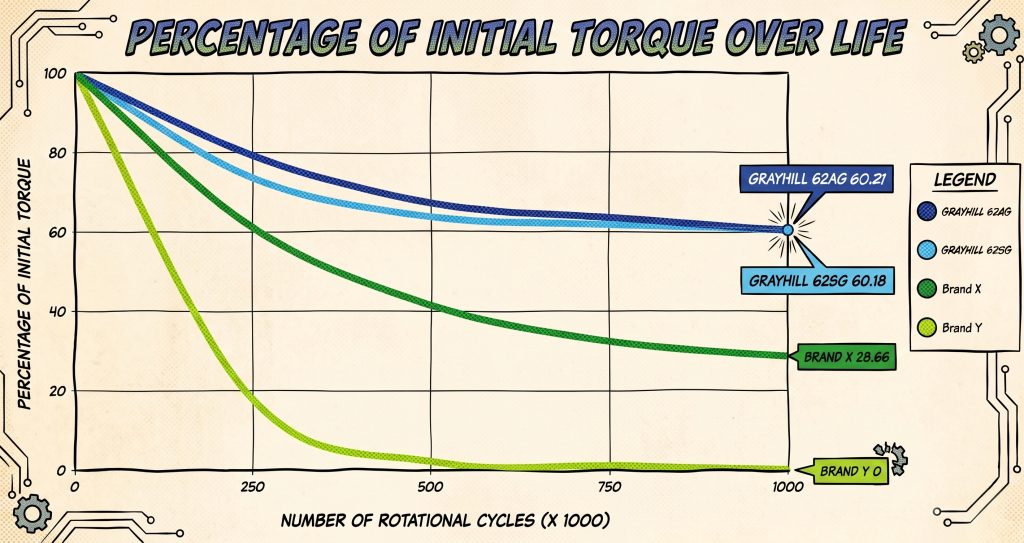
For our encoders, that threshold is ±50% of the initial torque value. This is the point at which positional feel has changed enough to introduce operator uncertainty. We declare end of life there — not when the component eventually stops working altogether.
What Torque Drift Looks Like Before Anyone Catches It
Torque drift doesn't announce itself. It accumulates quietly, detent by detent, until the haptic feedback the operator has been trained to trust is no longer delivering the positional accuracy they depend on. The degradation follows a predictable pattern:
- Detent crispness erodes. The tactile distinction between positions softens and the crispness of each click begins to disappear.
- Optical response times increase. The encoder is still moving, but the signal is falling behind the input.
- Operators lose positional confidence. The knob still turns and the system still responds, but the operator can no longer trust that the position they selected is the right one.
The problem is that some encoders reach the third phase far earlier than their published cycle ratings suggest. The drift that compromises positional accuracy is already well underway before the rated life is ever approached.
The data is clear: Brands X and Y suffer severe torque drift before hitting 250,000 cycles, while Grayhill's 62AG and 62SG maintain over 60% of their initial torque at a million cycles.
Which Manufacturing Standards Back Up an Encoder's Cycle Rating?
Can your communications interface handle a -40 °F morning and still feel like a precision instrument?
There is a vast difference between a component that "works" and one that "performs." A value encoder might pass a basic functional test, but the moment operating conditions push toward the extremes, performance erodes quickly.
A 10% price break looks good on a sourcing sheet. A mountain of warranty claims does not. The difference between the two often comes down to how seriously a manufacturer takes their cycle rating — and how much of the process they actually control.

The Bedrock of Vertically Integrated Manufacturing
At Grayhill, our unfailing precision is the result of vertical integration, a pillar of our company since 1943. While many competitors are simply assemblers — buying housings from one vendor and internal components from another — Grayhill controls the entire lifecycle of the component.
Military manufacturing is where Grayhill's quality standards were developed. Those same standards go into every product we build, from surgical suites to the Orion Spacecraft.
What Is Vertically Integrated Manufacturing?
It means we design and build our own tooling, molds, and automated assembly equipment in-house. We don't just order parts. We engineer the machines that make the parts.
The Benefits of Grayhill's In-House Manufacturing
- Eliminating tolerance stack-up. When parts come from multiple external vendors, tiny variations in each piece can stack up, leading to a finished product with soft actuation or inconsistent rotation. Because we mold our own detent housings, we hold incredibly tight tolerances that ensure every click is identical.
- APQP and material integrity. We use Advanced Product Quality Planning (APQP) to integrate quality from the initial concept. This includes selecting our own raw materials, such as our 96.5% tin / 3% silver / 0.5% copper solder blend, specifically chosen to prevent joint fractures under high vibration.
- Speed to market. Our fully equipped toolroom allows us to design and maintain molds with precision. This keeps us on schedule by minimizing the risk of supply chain interruptions or quality drift.

How Grayhill Tests So You Don't Find Out the Hard Way
Grayhill's accredited in-house laboratories permit fast and accurate verification to global and military standards, including MIL-STD-202, MIL-STD-810, IEC 60529 (IP ratings), and AS9100 Revision D. We subject our components to combined stress environments that reflect the extreme operating conditions our encoders may face.
- Thermal extremes. Spun simultaneously at 185 °F and -40 °F (85 °C and -40 °C) to expose lubricant thickening and plastic expansion that room-temperature testing never reveals.
- Vibration and shock. 15g of continuous vibration for 12 hours and 100g shock loads applied to validate structural integrity under real-world impact conditions.
- Optical performance. Contactless rise time validated to stay under 30 ms regardless of thermal or vibration state.
- Haptic performance. Detent crispness confirmed across the full stress envelope — not just at the comfortable middle.
Mission-critical applications demand components that hold their performance standard regardless of the environment.

How Grayhill Engineers for Long Lifecycles
Passing a lab test under combined stress is only meaningful if the construction holds up in the field. Grayhill's physical design is built to the same standard as our testing:
- IP67-sealed housing. Protects internal optics against moisture, cleaning fluids, and dust ingress.
- Contactless light pipe technology. Our patented design eliminates the physical wear cycle that plagues traditional encoders. Competing encoders rely on mechanical contact that generates metal shavings and debris, causing miscodes and signal degradation after only 30,000 cycles.
- Flat performance curve. Maintained from first use to rated end of life, so warranty exposure stays predictable and operators get the same response on day one thousand as they did on day one.
When we say Everything Clicks, we mean every click holds up to 1 million cycles — whether the encoder is on an Antarctic research station or a harvester armrest in the tropics.

The Difference Is in the Details
Behind every inflated cycle rating is a definition engineered to impress, not to perform. For the OEMs who trusted that misleading number, the consequences show up as warranty returns, field failures, and reputational damage that no spec sheet ever warned them about.
Behind every Grayhill rating is a vertically integrated manufacturing process, a test-to-failure culture, and a performance curve that stays flat from the first click to the millionth. The difference shows up in the application, in the warranty returns, and in the trust your customers place in your product.
Next in the series: Does a "1-Million-Cycle Encoder" Really Last a Million Cycles? — a closer look at the math behind inflated ratings, and the 50-year gap hiding in two identical-looking spec sheets.
Want to know which competitors are inflating their numbers?
Contact a Grayhill engineer today for a deep dive into our comparative test data.