









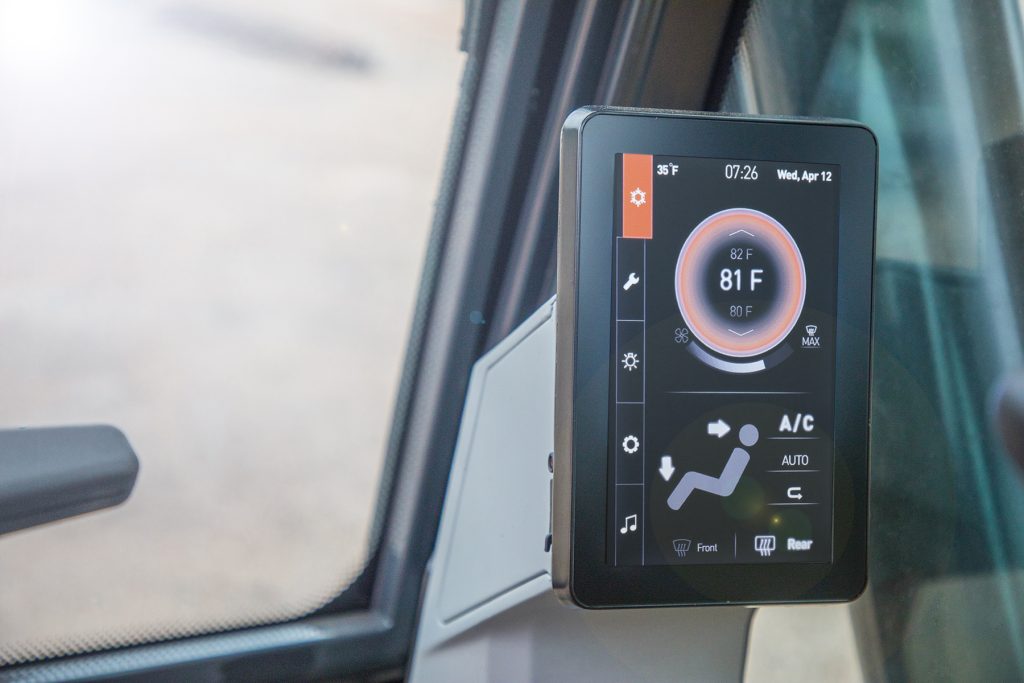
Displays, indicators, and optical user interfaces must remain clear and easy to interpret in bright outdoor environments. Sunlight is one of the most challenging conditions for human-machine interface performance because it introduces intense luminance, reflected glare, UV exposure, and spectral conditions that can wash out, distort, or obscure a visual signal.
For components used in aerospace, defense, medical, industrial, or off-highway applications, a display that becomes unreadable in sunlight can directly compromise usability, situational awareness, or operator safety. This is why Grayhill evaluates sunlight readability to assess brightness, contrast ratio, glare resistance, reflectance, and color stability under realistic illumination conditions.
Sunlight readability testing combines optical measurement principles with environmental exposure methods to help engineers understand how a display will behave when exposed to direct solar irradiance or strong ambient light. The results guide backlight design, optical layering, material selection, anti-reflection treatments, and UI considerations for long-term performance.
Why Sunlight Degrades Display Readability
Sunlight affects optical interfaces in several measurable ways:
- High ambient luminance reduces contrast ratio
Human vision detects contrast, not absolute brightness. In bright sunlight, ambient luminance increases drastically, reducing the display’s perceived contrast ratio. If contrast falls too low, text and symbols become unreadable. - Reflections overwhelm display content
Internal reflections within the display stack and external reflections from the surface can combine to wash out the intended content. Glossy surfaces and poorly matched refractive indices amplify this effect. - Diffuse vs direct sunlight changes readability
Direct sun introduces veiling glare and can mask symbols or indicators. Diffuse light increases overall luminance but may be less directional. Both must be evaluated because field conditions vary. - UV exposure can shift color and degrade materials
Long-term ultraviolet exposure can cause yellowing, fading, or loss of uniformity in certain polymers, coatings, and liquid crystal materials.
These effects have been documented in optical engineering studies published by the Society for Information Display (SID), SAE International, and ISO visual ergonomics standards.

What Sunlight Readability Testing Evaluates
Grayhill evaluates several optical and environmental parameters to assess daytime readability under realistic operating conditions. These measurements align with widely accepted technical standards such as ISO 9241-303 for display performance, SAE J1757-1 for automotive display visibility, and established optical measurement practices used across aerospace and industrial design.
- Luminous Intensity
Luminous intensity measures the amount of light emitted in a specific direction. Displays with insufficient luminous intensity appear washed out in high ambient light conditions. Readability is strongly dependent on overcoming the ambient luminance of the environment. - Contrast Ratio
Contrast ratio is the ratio between the luminance of the display’s white state and its black state. In sunlight, the apparent contrast ratio drops because ambient light raises the black level. Testing helps verify that the display maintains enough contrast for legibility in outdoor conditions. - Reflections: Specular and Diffuse
Reflections come from two sources:- Specular reflection, which is mirror-like and directional
- Diffuse reflection, which scatters ambient light and brightens the display background
Sunlight readability evaluations assess both types of reflection, since high reflectance reduces readability, especially for lightly colored UI elements.
Direct vs Diffuse Sunlight Effects
Direct sunlight introduces sharp glare and can mask symbols or indicators. Diffuse daylight increases background illumination and affects perceived contrast. Both conditions are considered to replicate real-world use.
Color Stability Under UV Exposure
UV radiation can cause:
- Yellowing of cover lenses
- Color drift in backlit legends
- Fading of printed markings
- Changes in optical filter performance
UV exposure evaluation supports long-term color fidelity and prevents readability loss over extended outdoor service.
Industry Standards that Inform Sunlight Readability Testing
Sunlight readability is informed by a combination of optical performance and human factors standards:
- ISO 9241-303 – Visual display performance requirements and measurement methods
- SAE J1757-1 – Recommended practices for display visibility in high ambient light
- MIL-STD illumination criteria – Used for cockpit and outdoor interface requirements
- ASTM G154 / G155 – UV exposure methods for polymers and coatings
These standards help ensure that evaluations align with real-world conditions and objective measurement practices.
How Grayhill Evaluates Sunlight Readability
Grayhill evaluates sunlight readability using controlled lighting conditions and optical measurement techniques designed to simulate real-world high ambient light environments.
Testing is performed across varying illumination levels, viewing angles, and surface conditions to assess:
- Display brightness under load
- Contrast ratio degradation in high ambient light
- Reflection behavior and glare effects
- Washout thresholds under direct and indirect illumination
- Readability across different lighting conditions
- Color stability following environmental exposure
Engineers use these evaluations to assess the performance of overlays, coatings, filters, legends, optical stacks, and backlight designs.
How Grayhill Uses Test Data to Improve Interface Design
Sunlight readability data supports improvements such as:
- Optimizing backlight intensity and LED selection
- Choosing anti-reflective or anti-glare surface treatments
- Selecting materials with higher UV stability
- Reducing internal reflections in the optical stack
- Improving color contrast for outdoor visibility
- Adjusting legend density, stroke width, or icon design
These refinements help ensure that Grayhill displays and indicators remain readable and reliable in bright outdoor environments.

Customer Benefits
Customers operating equipment in outdoor or high-brightness conditions benefit from:
- More reliable daytime readability
- Stable performance across lighting conditions
- Increased safety through clearer indicators
- Reduced risk of visual misinterpretation
- Extended optical durability through UV-stable materials
For mission-critical and safety-critical applications, consistent readability is essential. Discover Grayhill's wide range of CAN bus displays at: https://grayhill.com/products/vehicle-controls/can-bus-displays/