











With a $24.4 billion down payment already authorized for FY2026 and a 2028 deadline for initial operational capability, the Golden Dome for America initiative is moving at a pace the defense industrial base hasn’t seen in a generation.
For Tier 1 and Tier 2 manufacturers, where you stand on the Golden Dome will define your defense portfolio for the next decade or more.
The Scalable Homeland Innovative Enterprise Layered Defense (SHIELD) initiative is the central contract vehicle for the Golden Dome, carrying $151 billion in contract value across a 10-year period that spans the full lifecycle from R&D through production and sustainment. Through its Indefinite Delivery, Indefinite Quantity (IDIQ) structure, SHIELD awards work rapidly among 2,440 qualified contractors competing for task orders with short response windows and rapid proposal development cycles.
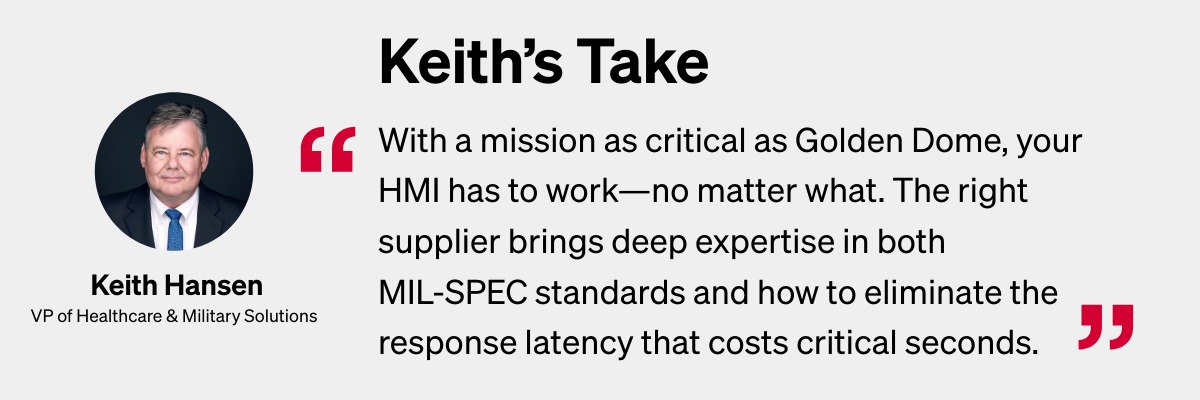
In a race to meet the Department of War’s (DoW) aggressive timeline, there is no room for an HMI control panel supplier who isn't already qualified and ready to scale.
The Scale of What’s Coming
The Golden Dome is intended to be built as a “system of systems” capable of protecting the United States from its adversaries. It includes space-based satellites equipped with sensors and interceptors, which would represent the first U.S. weapons deployed in orbit.
While originally planned as a five-year rollout, the (DoW) recently accelerated its strategy to spend the entire $152 billion defense reconciliation package (part of the One Big Beautiful Bill Act, of which $24.4 billion is allocated to the Golden Dome) within fiscal year 2026.
According to the Federal News Network, the $24.4 billion “downpayment” for the Golden Dome includes:
$7.2B—Development, procurement, and integration of space-based sensors (pending approval)
$5.6B—Development, procurement, and integration of space-based and boost-phase interceptor capabilities
$2.55B—Broader military missile defense capabilities
$2B—Airborne moving target indicator military satellites
$2B—Upgrading ground-based missile defense radars
$800M—Accelerating development of next-generation intercontinental ballistic missile (ICBM) defense systems
$530M—Design and construction of a missile range safety ship
$500M—National security space launch infrastructure improvements
$408M—Modernizing Army missile test range infrastructure in the Indo-Pacific
$250M—Directed energy capabilities development
Another $13.4 billion from the FY 2026 Defense Appropriations Act is focused on existing missile defense infrastructure that is critical for the Golden Dome.
With the program targeting an initial 2028 launch, traditional defense timelines are being scrapped. That’s roughly 36 months—and traditional defense acquisition timelines won’t survive the pace.
In a System of Systems, Every Interface Has to Be Right
At its core, the Golden Dome requires every contractor’s hardware, software, and systems to integrate across a single operational architecture. Every command node, launcher panel, and sensor interface must communicate cleanly across a multi-domain, multi-vendor network, and at a volume and velocity few defense suppliers have ever had to match. The wrong HMI supplier creates bottlenecks exactly where the program can least afford it.
What Should You Demand From Your HMI Supplier?
Pre-Qualified Hardware, Ready to Prototype
There is no time to start from scratch. Your supplier should arrive with a library of MIL-STD-810H-tested building blocks that can be configured into a functional prototype in weeks, not years. If the conversation starts with “We need to research how to make that happen,” it’s time to find a different partner.
MOSA-Native Integration
The Golden Dome is being built on the DoW’s Modular Open Systems Approach. Your HMI supplier needs native fluency in open-architecture communication protocols (SPI, USB, PWM, and I²C) so their hardware integrates without proprietary workarounds that compound at the system level.
Auditable Supply Chain Genealogy
Golden Dome suppliers throughout the ecosystem must provide complete Bills of Materials covering hardware, software, firmware, microelectronics, and raw materials. An HMI supplier who cannot produce documented Country of Origin (COO) traceability and NDAA Section 5949 compliance is a liability waiting to surface at your next DCMA audit.
Cybersecurity Posture
Not every HMI supplier is built to handle Controlled Unclassified Information (CUI). In a program like the Golden Dome, your HMI supplier has to be. Before you sign, confirm they have the certifications, access controls, and data handling protocols that CUI compliance actually requires.
Full-Spectrum Environmental Qualification
Demand raw test data across MIL-STD-810H (shock, vibration, temperature), MIL-STD-461G (EMC/ESD), and MIL-STD-3009 (NVG compatibility). A supplier who can hand you that data before your critical design review has already done the hard work up front.
Domestic Production Scalability
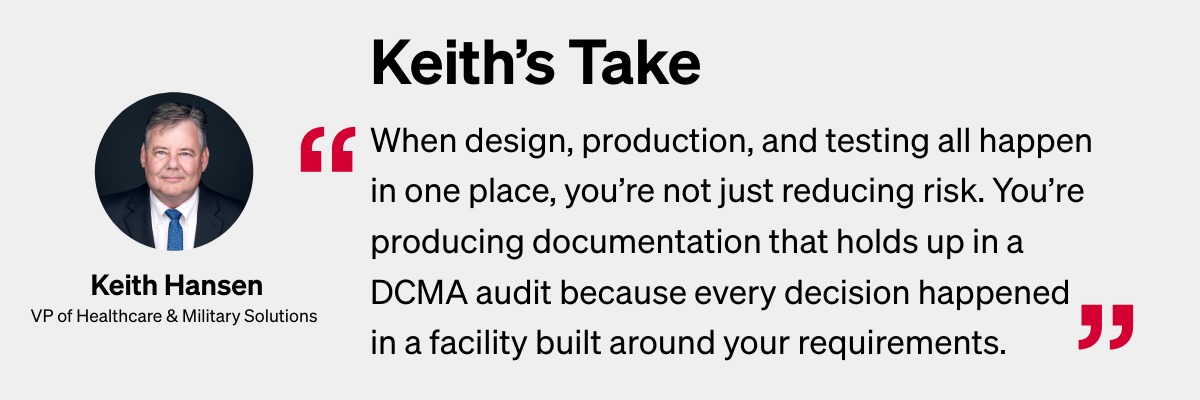
Your program can scale with a vertically integrated U.S. manufacturer who owns their own plastic molding, PCB assembly, photometers for NVIS compliance, and 100% In-Circuit Test capability under one roof. Suppliers who manage these processes in-house in the U.S. limit the risks posed by offshore manufacturing.
The Bottom Line
At the Golden Dome’s scale and timeline, your HMI supplier either meets the program’s requirements or becomes a liability across the entire supply chain. There is no middle ground. Grayhill was engineered for exactly this kind of program—with MIL-SPEC qualified hardware, MOSA-compatible architecture, and U.S.-based manufacturing built to scale when the program demands it.
Ready to evaluate your HMI supplier against the Golden Dome’s requirements?
Download the complete HMI Supply Chain Handbook, including compliance standards, testing requirements, and a Mission Readiness Checklist.