














A switch that works correctly when new has passed only the first test. For equipment expected to remain in service for years, engineers also need to know what happens after thousands, hundreds of thousands, or even millions of actuations. That is the purpose of life cycle testing.
GRAYHILL performs life testing as part of its in-house product testing capabilities, which include operational life and mean time between failures (MTBF) labs. Life testing helps engineers answer a fundamental reliability question: Will this component continue to perform as intended after repeated real-world use?
What Is Life Cycle Testing?
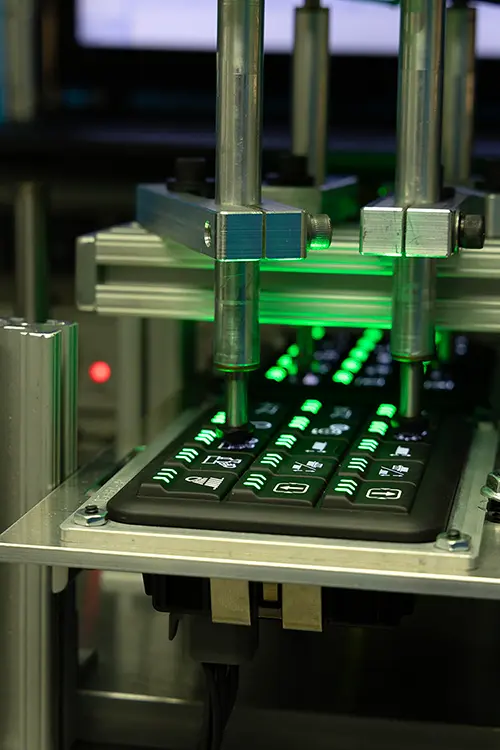
Life cycle testing evaluates the durability of a component by repeatedly operating it through a defined number of cycles and measuring whether critical electrical and mechanical characteristics remain within specification. For a pushbutton switch, one cycle consists of a press and release — repeated thousands or millions of times depending on the component's specified mechanical life.
GRAYHILL's testing resources identify typical mechanical-life specifications ranging from 10,000 to 10,000,000 cycles. The appropriate requirement depends on the product and its application. Reaching a specified cycle count, however, is only part of the durability story — engineers also need to verify that key electrical characteristics remain within specification as the component accumulates use.
What Does Life Cycle Testing Measure?
Life cycle testing for mechanical switches measures three characteristics: mechanical life (how many cycles the component can withstand before failure), contact resistance (the electrical resistance across contacts when actuated), and insulation resistance (the electrical isolation between contacts when the switch is not actuated). Together, these provide a complete picture of long-term performance.
Mechanical Life
Mechanical life measures how many operating cycles a switch can withstand before mechanical failure. For a pushbutton, each press and release counts as one cycle. GRAYHILL's testing documentation identifies a typical range of 10,000 to 10,000,000 cycles.
That number becomes most meaningful when compared against the expected duty cycle of the finished equipment. Two controls with identical cycle-life ratings can have very different expected service lives in the field — one actuated a few times per day, another hundreds of times per shift. Cycle-life requirements should always be evaluated in the context of the application, not simply as a number on a datasheet.
Contact Resistance
Contact resistance measures the resistance between contacts when the pushbutton is actuated. GRAYHILL's life-testing documentation identifies a typical specification of 100 mΩ maximum.
A switch may still physically actuate after extensive cycling, but mechanical movement alone does not confirm that its electrical performance remains acceptable. Monitoring contact resistance provides direct evidence of whether the electrical connection continues to meet its specified requirements across the component's rated life.
Insulation Resistance
Insulation resistance measures the resistance between contacts when the switch is not actuated — the electrical isolation the switch maintains at rest. GRAYHILL's testing documentation identifies a typical specification of 100 MΩ minimum at 100 V.
Evaluating insulation resistance alongside mechanical life and contact resistance provides a more complete indication of whether a switch continues to meet its electrical requirements after extended use.
Why Cycle Count Alone Does Not Tell the Whole Story
A component's cycle count tells you how many operations it completed — not whether it continued to meet its performance requirements throughout those operations. Mechanical life, contact resistance, and insulation resistance together determine whether a component remains within its defined specifications, which is the more useful engineering question.
It is easy to reduce durability to a single number: one million cycles, five million cycles, ten million cycles. But the more useful engineering question is not simply Did the component complete the cycles? — it is Did the component continue to meet its performance requirements throughout its expected life? Evaluating all three characteristics allows engineers to look beyond cycle count and assess real long-term condition.
What Is MIL-STD-202 Method 310?
MIL-STD-202 Method 310 is a standardized test method for evaluating the mechanical life of switching components through repeated operation. It specifies the procedure for cycling a switch and defines how electrical characteristics are evaluated — but the required cycle count, electrical requirements, and acceptance criteria depend on the specific component and its applicable specification.
GRAYHILL uses MIL-STD-202 Method 310 as part of its mechanical life-testing capabilities. There is no universal cycle count that defines a "durable" switch. The appropriate requirement depends on the control, its application, and its expected frequency of use — which is why design engineers should apply this standard in application context, not as a fixed threshold.
How to Translate Mechanical Life Into Real-World Use
To apply a cycle-life specification meaningfully, engineers should calculate expected field use based on the application's duty cycle and service life, then compare that against the component's rated mechanical life with an appropriate margin.
When selecting a switch or control for a demanding application, engineers should consider:
- How many times will the control typically be actuated per hour, shift, or day?
- How many years is the equipment expected to remain in service?
- What electrical characteristics must remain within specification throughout that period?
- What constitutes end of life for the component in this application?
- What margin is appropriate between expected field use and the component's rated mechanical life?
For frequently operated HMI components on industrial equipment, off-highway vehicles, medical equipment, or military systems, those calculations can significantly influence component selection.
Why In-House Life Testing Matters
In-house life testing allows durability evaluation to be integrated directly into the product development and validation process, rather than treated as an isolated event. GRAYHILL maintains operational life and MTBF labs alongside environmental laboratories covering temperature, humidity, sealing, shock, vibration, salt spray, chemical resistance, sunlight readability, and more.
This testing connects directly with GRAYHILL's broader quality framework — including APQP, product validation, supplier PPAP, PFMEA, control plans, and production quality processes. The objective is to understand product performance before the component reaches the customer's application.

Long-Term Reliability Is Proven One Cycle at a Time
Life cycle testing gives engineers measurable evidence of how a component performs under repeated use. Mechanical life establishes how many cycles the component can withstand. Contact resistance evaluates the electrical connection when actuated. Insulation resistance evaluates electrical isolation when it is not. Together, they provide a more complete picture of long-term durability than cycle count alone.
For equipment expected to operate reliably for years, that matters — because products that are built to last have to be tested to last.